Inspector - Simulation debugging tool

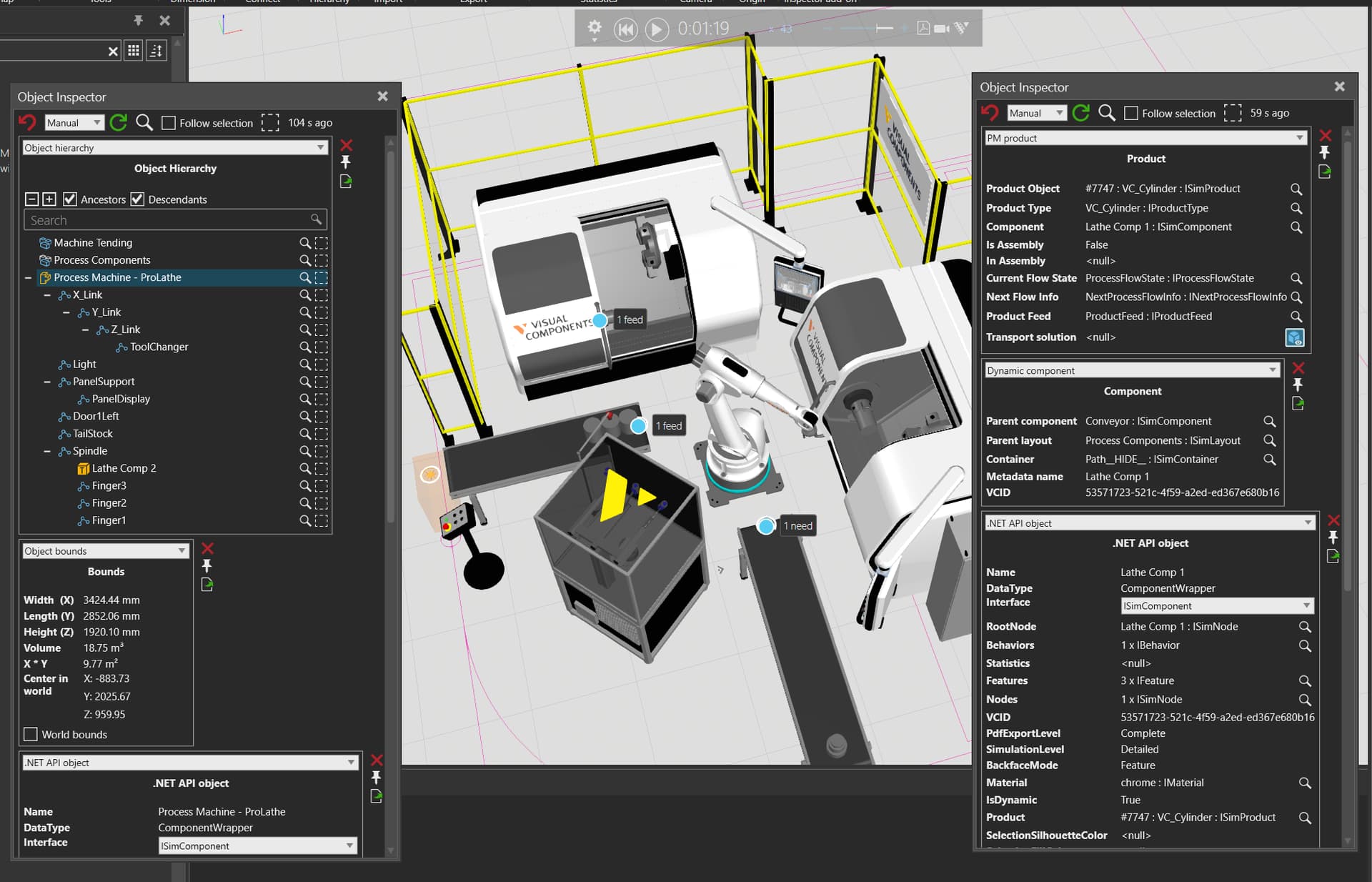
The Inspector .NET add-on helps understand simulation state and behavior by showing detailed information about simulation objects. The focus is on read-only access to information which is not easily accessible from VC Premium’s user interface.

The Inspector can be used to see things like details of PM product matching and flow, full simulation node hierarchy, C# properties of any .NET API object etc.

Video explaining the core concepts and use:

Gadgets included in the first release:

  • PM product: Show basic info and flow state, visualize current transport solution of product instance.
  • PM product matcher: Collects and visualizes product need and feed matches in layout. Visualizes matches, pending product needs and feeds in 3D overlay.
  • Object bounds: Show dimensions of any IVisualObject bounding volume.
  • Dynamic component: Shows parent component and component container of simulation runtime component.
  • Object hierarchy: Shows full simulation node (ISimNode) hierarchy tree, including dynamic components, and component internals.
  • Property container: Shows searchable & inspectable list of names and values of IProperties from any IPropertyContainer.
  • .NET API object: Shows C# properties of any API object organized by interface.
  • Inspectable collection: Lists contents of any .NET IEnumerable collection and allows inspecting the values.

Download:
For Visual Components 5:
Plugin.Inspector.Bootstrap.vc5.zip (11.0 KB)

For Visual Components versions from 4.9.1 to 4.10.2:
Inspector add-on.zip (10.7 KB)

The inspector add-on is only available for Visual Components 4.9.1 (released 29th Aug 2024) and newer.
Extract the Plugin.Inspector.Bootstrap.dll to your Visual Components installation directory, then run VC.

The add-on updates itself automatically.

7 Likes

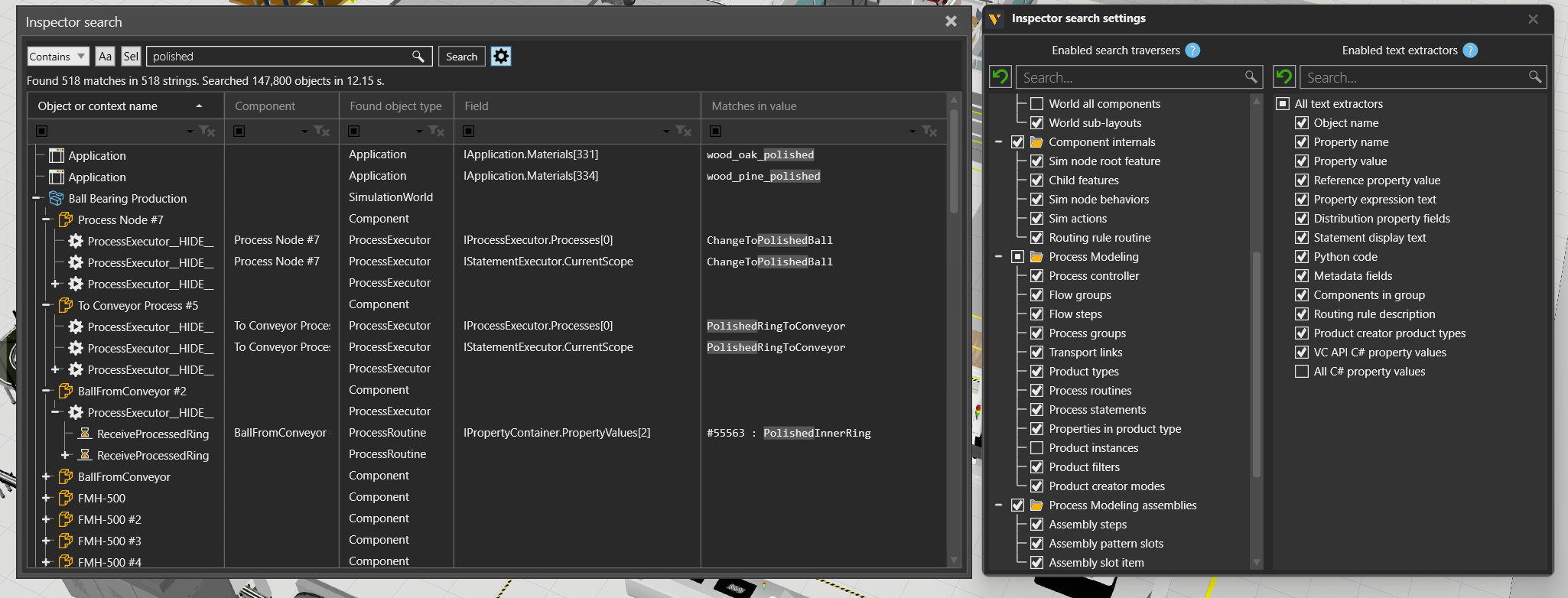
Inspector version 2.0 with advanced search is now out!

Inspector version 2.0 adds a powerful advanced search feature. It can find text from almost anywhere deep in the simulation layout and presents the results in a convenient tree structure with context such as parent component.

The search also provides few different ways to utilize the results, like copying values or automatically opening the appropriate VC UI for editing the found object.

Major features

  • Deep search of simulation objects, including:
    • Static and dynamic component internals
    • Python scripts
    • Expressions
    • PM and robot statements
    • PM objects such as product types and assemblies
    • Reference properties
    • etc.
  • Contains, wildcards, and regex search.
  • “Goto” which opens the appropriate UI for viewing and editing a found object.
  • Powerful advanced filtering of results using a tree grid control

Limitations

  • Can’t find anything from add-ons such as VC OLP or KUKA.Sim add-on. These have their own internal data models of which the inspector can’t know anything.
  • The search uses APIs not available in VC Essentials, so the Inspector add-on is not available for that anymore.
  • The search is based on matching extracted text values, so finding combinations or numerical values such as e.g. “Objects that have a property with certain value” can be tricky.
6 Likes

Advanced search settings added in version 2.2.

What areas of simulation the inspector search covers can now be controlled in much finer detail, which helps filter out unwanted results. This version also further expands the search scope with a generic API traverser and text extractors which come with some compromises and are disabled by default.

Narrated explanation and demo:

5 Likes

Hi, where can I download the latest release of the Inspector Tool for VC version 4.10?

It’s already the latest version

1 Like

Version 2.5 now available

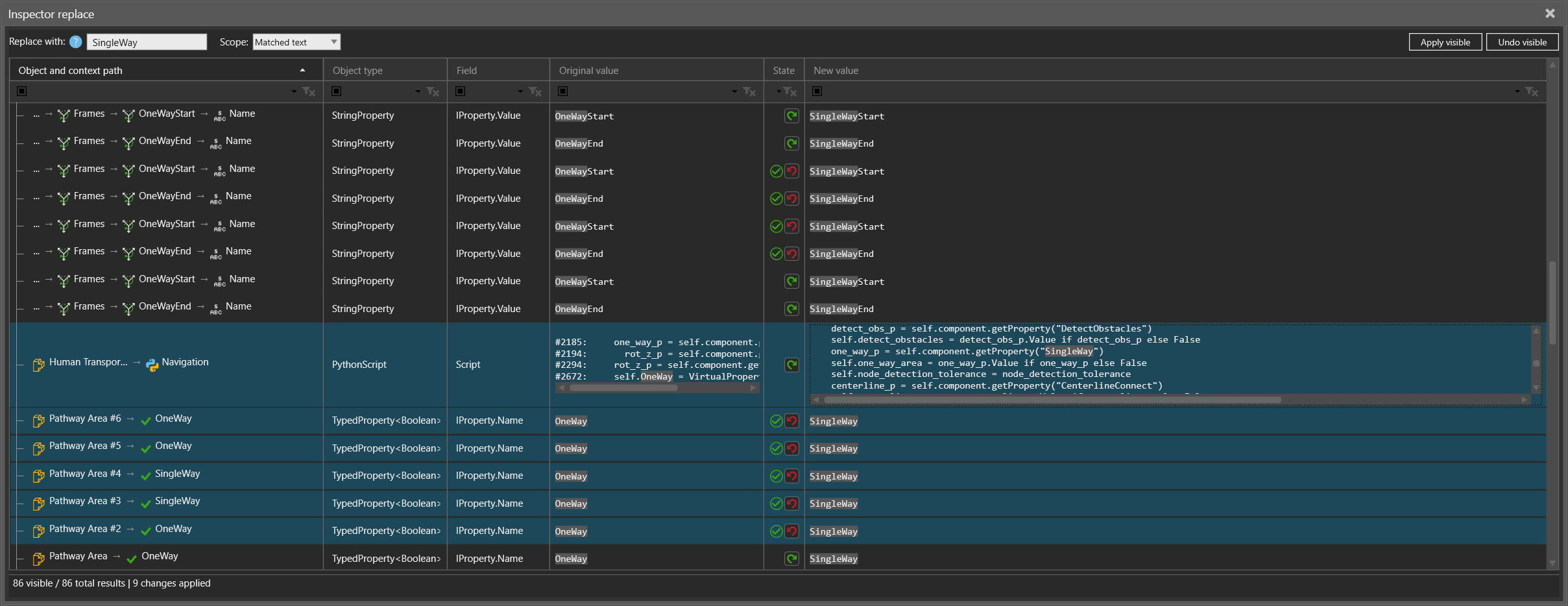
Inspector version 2.5 adds powerful text replacement functionality and extends search to cover simulation interfaces.

What’s New

Text Replace

  • Find and replace text and numerical values across simulation
  • Regex and whole line replace support
  • Preview changes before applying
  • Undo support

Interface Search

  • Search through simulation interfaces, their content and connections

Narrated demonstration video


The Inspector add-on updates itself automatically if your VC version is still supported.

7 Likes

How can I obtain the latest plugins?

You can download the file in the first post. The add-on updates itself automatically.

Hi, It says Inspector: Fail to get lastest inspector installer imformation from server when I run VC.
How can I fix this problem?

Are you behind a strict firewall? It needs to access a backend service in Microsoft Azure hosted in Europe.

Well, yes. Thank you for this information. I will ask the IT guys in my company to help me access the Azure-hosted service.

Inspector has been added to Addon Store - Manage your addon installations for 4.9.1 to 4.10.X (Professional & Premium)

1 Like

Inspector add-on 3.0 for VC 5 — AI Meets Your Simulation

TL;DR: Have a conversation with an AI about your VC layout. Ask questions in plain English, get answers about your factory layout, Process Modeling, and material flows. The AI reads your live simulation data through an embedded MCP server in the Inspector add-on.

Inspector 3.0 requires Visual Components 5. It is not available for VC 4.x.


What is Inspector 3.0?

Inspector 3.0 turns your running Visual Components simulation into an AI-readable data source using an embedded MCP (Model Context Protocol) server. By connecting GitHub Copilot in VS Code, you can issue complex tasks in natural language, and the AI will autonomously use 21 specialized tools to browse, analyze, and document your layout.

Read-only & Safe: The AI can observe, query, take screenshots, and analyze your simulation, but it cannot modify your layout. This prevents the AI from breaking your model. It can only change UI states (select, move camera, pause/play) and create interactive Notes in VC.

Example Tasks:

  • “Generate a markdown report with a mermaid diagram of the material flow and screenshots of each work cell in the vc layout.”
  • “Analyze all signal connections in vc. Find any disconnected interfaces and document them.”
  • “Run the vc simulation to 10 minutes, take a screenshot, and check for queue buildups.”

Quick Setup

1. Install the Add-on:
Download Plugin.Inspector.Bootstrap.vc5.dll from here and place it in your VC 5 install folder (e.g., C:\Program Files\Visual Components\Visual Components Premium 5.0\). Restart VC.
Plugin.Inspector.Bootstrap.vc5.zip (11.0 KB)

2. Start the MCP Server:
In Visual Components, navigate to the Inspector ribbon group, open the MCP Server dialog, and start the server (it is not enabled by default).

3. Connect VS Code:
Create a .vscode/mcp.json file in your workspace:

{
  "servers": {
    "visual-components": {
      "type": "http",
      "url": "http://localhost:3000/mcp"
    }
  }
}

4. Start Chatting:
In VS Code, open Copilot Chat, switch to Agent mode, enable the visual-components tools, and start asking questions!

See the Quick Start Guide for full details and the complete tool list
inspector-3.0-quick-start-guide-public.pdf (442.2 KB)


Requirements

  • Visual Components 5 (excluding Essentials)
  • VS Code with GitHub Copilot or other MCP-compatible AI agent

Feedback Wanted! Let me know what workflows are most useful, where the AI struggles, and any bugs you find. Share your thoughts in this thread!

11 Likes

Hi, I’m using VC (5.0.1) which is the last version of VC now.
But, an error shows “the inspector is not available for VC platform versions 4.9.1 and newer, and updates are made only for the lastest VC version”.

The existing Inspector built for 5.0.0 seems to work in 5.0.1 so I have now enabled that in the installer backend.

1 Like

Hi, I have one question.
Looking at the example video, I saw that the layout configuration was configured using PM.
Can I use inspector AI functionality even if I configure the layout using modeling and python without using PM functionality?

Best regards,

The MCP server has some specialized tools for PM as that is the common structured / standard way of modeling layouts, which makes things like tracing material flows easier. With your own Python scripting everything is more or less custom.

However, the MCP server also has tools for extracting Python scripts from VC to the Copilot workspace folders, which the copilot can then read and reason about. If you use some specific modeling practices, you could give that info to copilot as agent skills or just text files in your workspace to help it understand how your scripts work and interact.

1 Like

When using this add-on with a platform product based on Visual Components, the following error occurs.

Inspector: The inspector add-on is not available for this version or product variant of Visual Components.
The inspector add-on is only available for VC platform versions 4.9.1 and newer, and updates are made only for the latest VC version.
Inspector: Failed to install the inspector add-on.

I selected the correct version’s DLL and placed it in the correct installation folder.

Is this add-on compatible with a platform product based on Visual Components ?

Could you please explain the possible cause of this error?

How the installer / auto-update system works is that the VC side sends the version info from ICustomizationService.ApplicationVersion to the server and then the server checks its catalog for any available version of the plugin.

If the OEM product based on VC doesn’t use same version numbers as the VC products, it won’t work. I think there isn’t API available to get the “VC platform version” which would be the correct version number to use in these cases.

Also there is no accounting for any API availability due to licensing and feature differences. I don’t have any capability to test against any OEM variants, nor the more limited VC variants either.

1 Like

Inspector 3.5 Beta for VC 5.1: Copilot Chat and AI-Assisted Editing

TL;DR: Inspector 3.5 beta adds an experimental Copilot chat directly inside Visual Components, new opt-in editing and automation capabilities, and a packaged Visual Components focused workspace for scripting and Python migration workflows.

Inspector 3.5 beta requires Visual Components 5.1.


Inspector 3.5 beta expands Inspector from a mostly read-oriented AI inspection bridge into a more complete AI-assisted workflow for Visual Components.

Main features in this beta:

  • Copilot chat inside Visual Components with Ask mode for investigation and Edit mode for approved editing workflows
  • Opt-in layout and component automation for larger tasks such as changing machine configuration, updating process settings, and saving revised layouts or components
  • eCat catalog search and insertion for finding components and example layouts from the catalog of over 4000 models, then loading and positioning selected content
  • Process Modeling troubleshooting support for diagnosing broken flows, transport issues, runtime state, and output errors
  • Improved Python script workflows for exporting, editing, validating, importing, and migrating scripts from Python 2 to Python 3
  • Packaged Copilot workspace with Visual Components specific guidance, Python API reference material, migration support, and helper tooling

Editing capabilities are not enabled silently. Inspector prompts user before allowing tools that can modify files or the live layout.

Example things to try in the beta:

Export the Python scripts from this layout, summarize what each one does, and prepare a migration plan for the Python 2 scripts.
Export the Python 3 script from the selected component, make [describe the script change], validate it, and import it back into the layout in this session.
Investigate why products are not reaching the selected machine, or why they arrive there but never leave. Use the current viewport and selection for context, then check process configuration, transport links, runtime state, and output errors before suggesting changes.
Test these process changes in this copied layout around the selected process or visible work cell: set the failure settings to [failure settings], update the process-time delay to [duration], try [transport link change], and save the result as a new layout version.
Search eCat for robot families suitable for [payload/reach/task], explain the most relevant manufacturer naming patterns you find, and suggest components or example layouts to try.
Build a simple test layout from eCat content for [process goal]: search for suitable components, insert them, position them, create the basic Process Modeling flow, and run a quick test.

More detailed guide: Inspector 3.5 beta user guide.pdf (159.8 KB)


Beta Installation

  1. Install the current Inspector add-on for Visual Components 5.1.
  2. Start Visual Components once so Inspector creates its settings, then close Visual Components.
  3. In File Explorer, open shell:Personal (My Documents folder), then edit this file:
Visual Components\5.1\Inspector\Installer settings.json
  1. Change:
"ReleaseChannel": null

to:

"ReleaseChannel": "beta"
  1. Start Visual Components again and let Inspector install the beta update and Copilot workspace.

The first beta install can take several minutes because it downloads and extracts both the add-on update and the packaged workspace.

This is still a beta, and the Copilot chat integration is experimental. Please try it with copied layouts where possible and share feedback about installation, chat usability, edit-mode safety, script workflows, and Python 2 to Python 3 migration results.

PS: There likely won’t be any updates for about 3 months due to summer holiday season.
4 Likes